
Why Your Eyes Might Be the First Place Your Thyroid Shows Up
Why Your Eyes Might Be the First Place Your Thyroid Shows Up
This week is Thyroid Eye Disease Awareness Week, so let's talk about something I see more often than most people expect: eyes that look a little different lately, and a thyroid that nobody has checked yet.
It's Not Always Allergies
If you came in worried that your eyes look puffier, wider, or just "off" somehow, the first thing I do is not jump to your thyroid. There are a handful of far more common explanations, and we rule those out first. Allergies can make the eyes look swollen and irritated. A string of bad sleep changes how your eyes sit and how alert they look. Sinus congestion backs up fluid around the eyes. Garden variety dry eye makes people squint, rub, and look tired even when they're not. Most of the time, one of these is the actual answer, and we treat that instead of sending you off for bloodwork you don't need.
When the Usual Suspects Don't Explain It
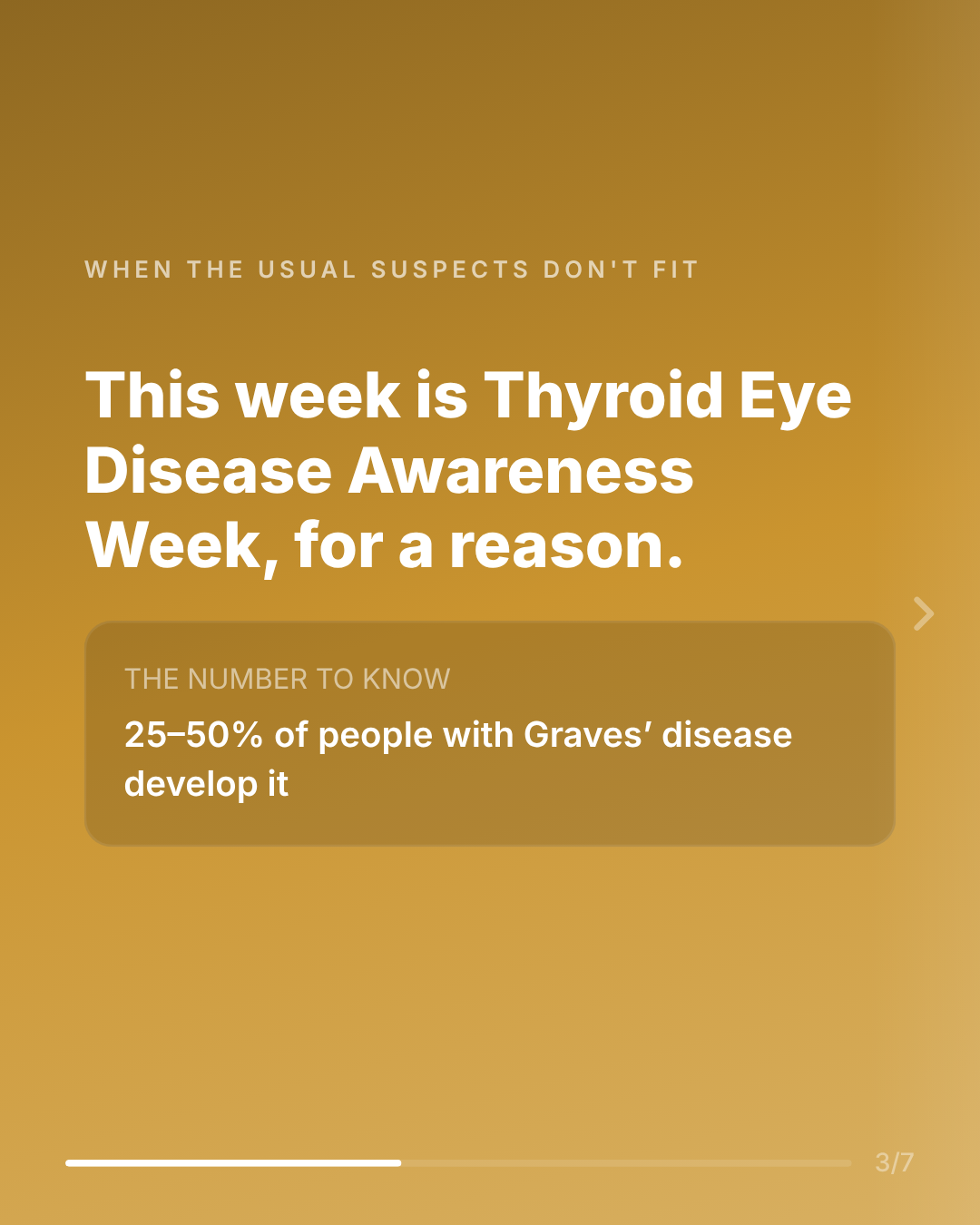
Occasionally, none of that fits. The eyes look more prominent than puffy. There's a staring quality to them that wasn't there a year ago. Eyelids sit a little higher than they used to, or don't fully close at night. Double vision shows up, especially by the end of the day. That's when I start asking about your thyroid, because this week's awareness campaign exists for a reason: thyroid eye disease, sometimes called Graves’ ophthalmopathy, shows up in the eyes before it shows up anywhere else for a meaningful number of patients. It's tied to autoimmune thyroid disease, most often Graves’ disease, and the estimates I trust put it at roughly a quarter to half of people with Graves’ developing some degree of it. Most cases end up mild. That doesn't mean skip the exam, it means the exam is usually good news.
What You Can Control Starting Today
Before we talk about any kind of targeted treatment, there's a short list of things that are entirely on you, and I'm going to hold you to it the same way I would with dry eye or anything else. Drink water and get real sleep. Your eyes are part of the rest of your body, not a separate system that gets to skip the basics. Stop rubbing your eyes, even when they're irritated, since rubbing makes inflamed tissue worse, not better. Use preservative-free artificial tears for the grit and dryness rather than white-knuckling it through the day. And if you smoke, this is the one that actually matters most here: smoking is the single biggest modifiable risk factor for thyroid eye disease getting worse, by a wide margin. None of this replaces a real workup if something is actually going on with your thyroid, but it's the part you don't need me for, and it's not optional.
Where This Needs a Team, Not Just Eye Drops
If what we're seeing stays mild, we manage it in the chair. Lubrication, protecting the surface of the eye, and tracking it over time with measurements and photos so we're comparing against something concrete instead of memory. If your labs haven't been checked, we loop in your primary care doctor or an endocrinologist, since thyroid eye disease is a thyroid problem that happens to live in your eyes, not the other way around. If the eye muscles are involved, or the eyelids genuinely won't close, or there's any pressure on the optic nerve, that's outside what an eye exam chair treats, and I refer you promptly to the right specialist rather than trying to manage it myself. You deserve the person who treats this for a living, not a generalist's best guess.
What Happens Next
If you're stable and mild, we recheck periodically. Not because I'm not paying attention in between, but because this is a condition that moves slowly enough that monthly check-ins would be overkill and yearly would be careless. If anything changes faster than that, new double vision, a real vision change, eyelids that suddenly won't close, you don't wait for the follow-up. You call.
Noticed your eyes looking different lately, puffier, drier, or like they're not quite closing right?
Schedule a thyroid eye evaluation at Golden State Optometry. Call (310) 395-5778 or book online.
Quick Links

All Eye Care Services

Keep In Touch
For non-urgent questions or to learn more about our services, contact us today!

Quick Links
Contact Info
- 1234 7th Street Suite #2
Santa Monica, CA 90401 - Phone: (310) 395-5778
- Fax: (310) 458-9754
Hours of Operation
- Monday 8:00am - 4:30pm*
- Tuesday 8:00am - 4:30pm**
- Wednesday 8:00am - 4:30pm*
- Thursday 8:00am - 4:30pm*
- Friday 8:00am - 4:30pm**
- Saturday Closed
- (Select Saturday appointments are available by request. Call or text (310) 395-5778 to check availability.)
- Sunday Closed
- Please note the following:
* We are closed 12:00 - 1:00 for lunch on Monday, Wednesday, and Thursday.
** We are closed 12:30 - 1:30 for lunch on Tuesday and Friday. - Monday
- Tuesday
- Wednesday
- Thursday
- Friday
- Saturday
- Sunday
- Monday
- Tuesday
- Wednesday
- Thursday
- Friday
- Saturday
- Sunday
© 2026 Golden State Optometry. All rights Reserved -
Accessibility Statement
-
Privacy Policy
-
Sitemap
Managed and Designed by 